
The Man In Command
What We Find To Be Consistent In Success

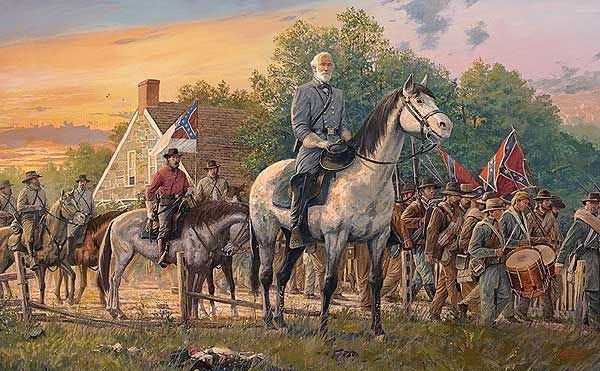
Jeffro made this Note the other day.
This bit got me thinking: “Meffridus taught players to take control of the game. The way Oghma did when he visited Trollopulous.”
That’s being The Man In Command.
What we are seeing in our various campaigns using Braunstein as our model is that the best players are those that step up and assume command. They are the ones that take control of a campaign’s direction such that they become one of the centers of gravity around which others revolve, and the best of them do this from the moment that man enters play.
Right now, in the Tower Campaign, we have a Fighter approaching Name Level. He’s taken his initial hiring of men-at-arms to follow him to and into dungeons and built that up into an army, an army that has allowed him to claim land and is now pacifying it in preparation for a declaration of dominion therein. I have every expectation that another Fighter on the map will soon follow that lead, while other mans on the table will each execute their own paths to mastery and command in due course.
All of the Factions in the campaign are always thinking in terms of What Needs To Be Done To Secure This Objective. The successful adventuring mans do the same thing, each according to their Class, Race, and Alignment.
This should be part-and-parcel of proper play. Focus on the mission; grade on player performance. What is clear is that part of the remedial effort in restoring the hobby is in restoring this expectation upon players, as the corporate-driven version goes out of its way to do the opposite. As it has done so for decades, that low-agency expectation is a unfortunate norm that needs to be corrected back to the high-agency prior norm.
We need, in short, to (re)train players back into a position of being In Command.
Ours is a hobby based on fulfilling the Fantasy of Agency. We should be taking the reigns in the campaigns we play in as best we can, setting the pace, making things happen. The games we focus upon have this built into their rules for this reason, and no other product worthy of consideration lacks this quality.
This process starts by approaching a situation with the questions of “What is the mission? What do we have to work with? How can we secure our position prior to pushing ahead?”
In short, not blundering ahead with no clue about what to do or how to do it like a bunch of no-agency mooks.
Which is part of why we also need Referees to step back to being disinterested parties, concerned only with the integrity of the campaign, and disinvested in any outcome.1
Instead, we must demand more agency from players and less from Referees- and players need to stop being shy about seizing the initiative and driving events in their favor.
A Man In Command sets the agenda; he has his mission, and play consists of him going about that mission as best he can. That mission may be issued by the Referee, typical for those assuming control of a faction, or it may be adopted by the player without any prompting but it needs to be there one way or the other and the better player will put his mind to pursuing and fulfilling it.
The flipside of low-agency players is overly-agentic Referees, which is where that false concept of this hobby being a Narrative medium stems from: having to pixelbitch via mind-reading the bad Referee until you get the Plot Coupon required to proceed down the railroad tracks.